The Mōn app

The Mōn app

The Mōn app

Increasing engagement with a sex positive social audio platform
MŌN - pronounced “moan”

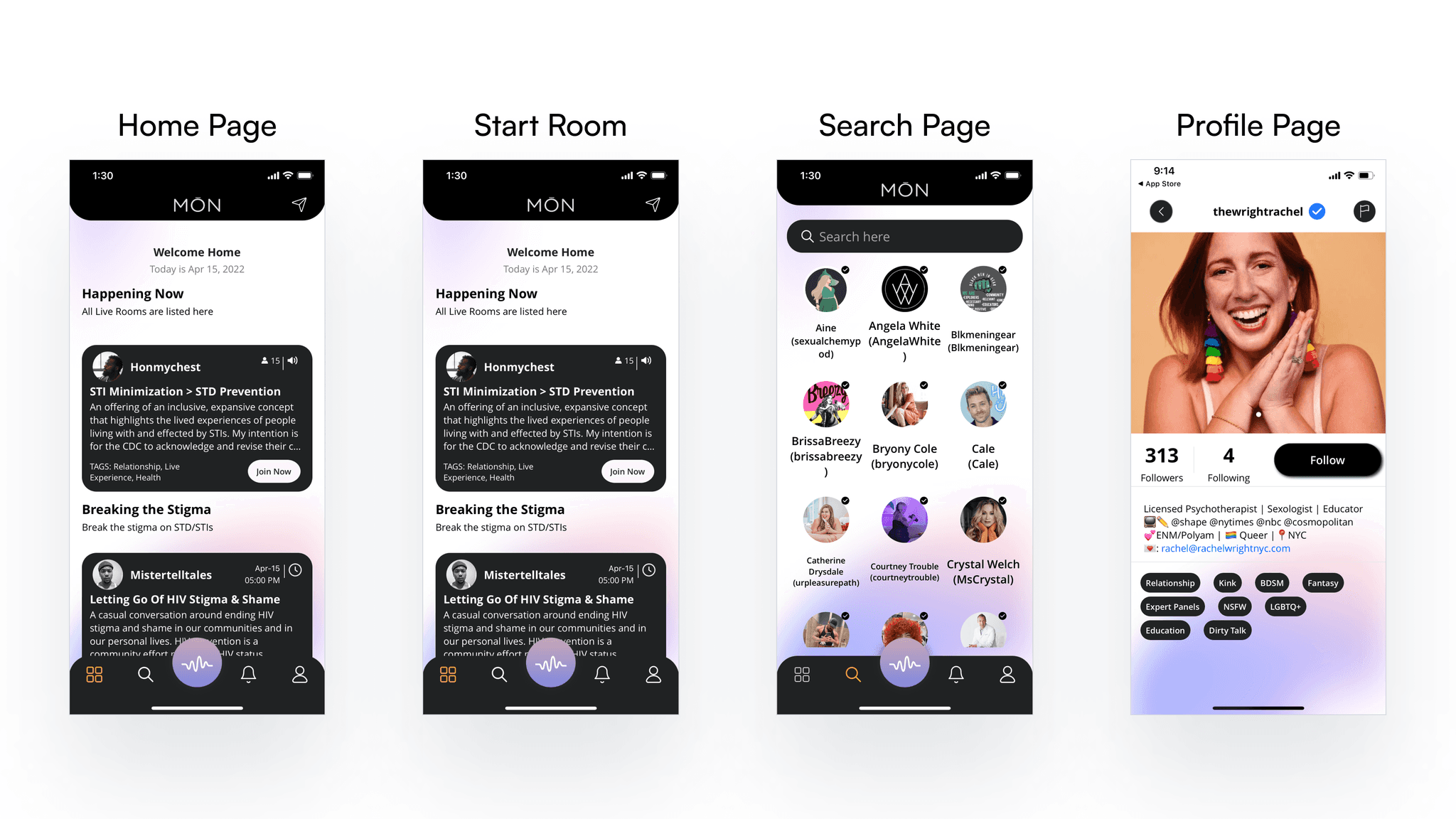
MŌN is a start-up located in Austin, Texas. The audio based app launched for IOS late 2021 and offers safe space for sex positive conversations. At the start of this project, users could join live rooms to voice chat with other users or start a live room themselves. Users include specialists, doctors, therapists, coaches, sex workers, sex positive content creators, and range to regular people who are curious, have particular interests, or prefer to remain
anonymous. Visual content on this social app is limited to approved profile pictures. MŌN’s founder/CEO, Caleth Jones, strives to foster high-brow, intellectual conversations and also maintains a strict NO censorship policy. This approach has attracted many sex positive content creators who have been recently de-platformed by major social media outlets.

In anticipation of MŌN’s next phase, Cale asked my team and I to design an audio memo feature which would allow users to record and post two minute audio clips. This feature would provided needed additional content, along with eventual podcast integration, prior to the app’s next phase of growth. We were also asked to consider how this new feature would be accessed by users and any other changes to the rest of the app that would need
to be made to accommodate this feature. My team was extremely excited by this project and it was our final/client project as students at General Assembly.

MŌN - pronounced “moan”

MŌN is a start-up located in Austin, Texas. The audio based app launched for IOS late 2021 and offers safe space for sex positive conversations. At the start of this project, users could join live rooms to voice chat with other users or start a live room themselves. Users include specialists, doctors, therapists, coaches, sex workers, sex positive content creators, and range to regular people who are curious, have particular interests, or prefer to remain
anonymous. Visual content on this social app is limited to approved profile pictures. MŌN’s founder/CEO, Caleth Jones, strives to foster high-brow, intellectual conversations and also maintains a strict NO censorship policy. This approach has attracted many sex positive content creators who have been recently de-platformed by major social media outlets.

In anticipation of MŌN’s next phase, Cale asked my team and I to design an audio memo feature which would allow users to record and post two minute audio clips. This feature would provided needed additional content, along with eventual podcast integration, prior to the app’s next phase of growth. We were also asked to consider how this new feature would be accessed by users and any other changes to the rest of the app that would need
to be made to accommodate this feature. My team was extremely excited by this project and it was our final/client project as students at General Assembly.

MŌN - pronounced “moan”

MŌN is a start-up located in Austin, Texas. The audio based app launched for IOS late 2021 and offers safe space for sex positive conversations. At the start of this project, users could join live rooms to voice chat with other users or start a live room themselves. Users include specialists, doctors, therapists, coaches, sex workers, sex positive content creators, and range to regular people who are curious, have particular interests, or prefer to remain
anonymous. Visual content on this social app is limited to approved profile pictures. MŌN’s founder/CEO, Caleth Jones, strives to foster high-brow, intellectual conversations and also maintains a strict NO censorship policy. This approach has attracted many sex positive content creators who have been recently de-platformed by major social media outlets.

In anticipation of MŌN’s next phase, Cale asked my team and I to design an audio memo feature which would allow users to record and post two minute audio clips. This feature would provided needed additional content, along with eventual podcast integration, prior to the app’s next phase of growth. We were also asked to consider how this new feature would be accessed by users and any other changes to the rest of the app that would need
to be made to accommodate this feature. My team was extremely excited by this project and it was our final/client project as students at General Assembly.

Project scope

Design a feature that allows users to post audio memos, which also allows for audio comments and replies, for MŌN’s next role out. Also address where this feature will live, how it will be interacted with.

Methods

  • User and client interviews

  • Surveys

  • Competitive analysis

  • Heuristic evaluation

  • Affinity & journey maps

  • Prototyping

  • A/B Testing

My role

Personally responsible for leading interaction design and usability testing.

Tools

  • Figma, Figjam

  • Adobe XD - final designs delivered in XD

  • Maze, Trello

Duration

3 week sprint 

Date

March 31 - April 20, 2022

Methods

  • Field expert interviews

  • Iterative design - wireframes & hi-fi

  • Testing with experts, CAB, internal, react prototype

Duration

  • 3 week initial research and design phase

  • ~ 1 year development & refinement  

Date

  • April-May 2023 initial research & design

  • May 2023 - May 2024 development & refinement

Mōn at the beginning of project

Research methodologies
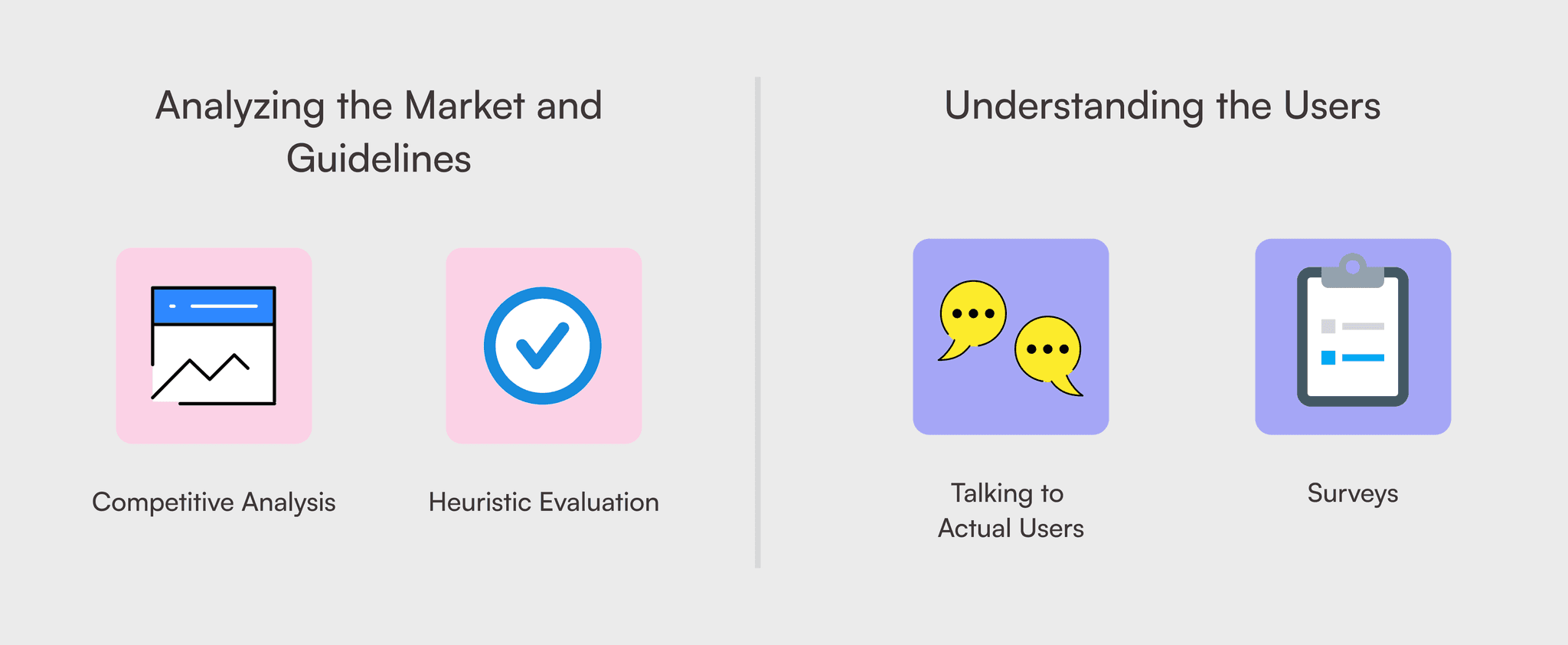
The team gained limited access to the MŌN’s user base due to the nature of this app. Despite being very public with their sex lives, users are understandably shy and concerned about privacy. To help us work around this, MŌN’s CEO offered us a solution that capitalized on his established report with the community.

MŌN’S CEO promoted and hosted a live room which acted as a group interview. He(Cale) even invited several of his featured users, who we identified as sex positive content creators. The turnout was a large room by MŌN standards, about twenty users. Our research team attended, provided MŌN’s CEO with a list of questions, and fed additional follow-up questions in real time. Our notes from this group interview yielded a substantial amount of data.

User personas
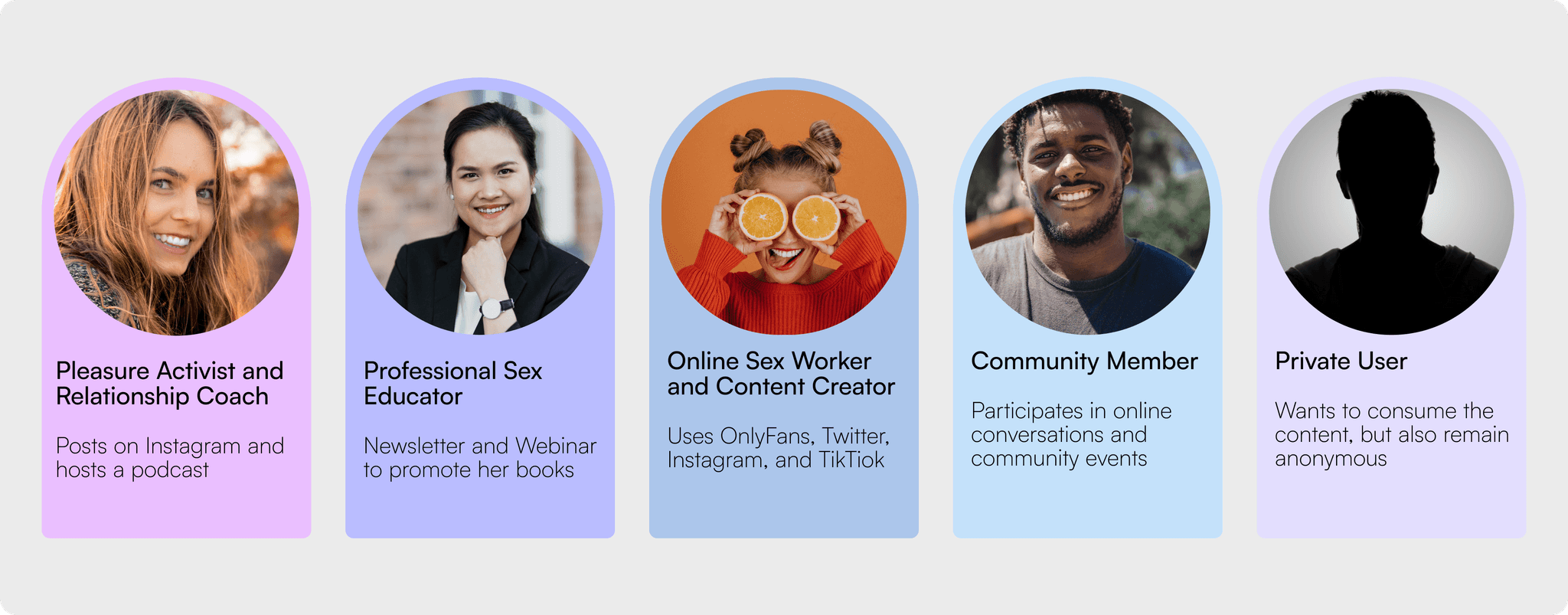
Additionally, we sent out four short-answer surveys which targeted the follow segments:

  • Sex positive content creators on MŌN (featured users)

  • Sex positive content creators NOT on MŌN

  • Sex positive content consumes on MŌN

  • Sex positive content consumers NOT on MŌN

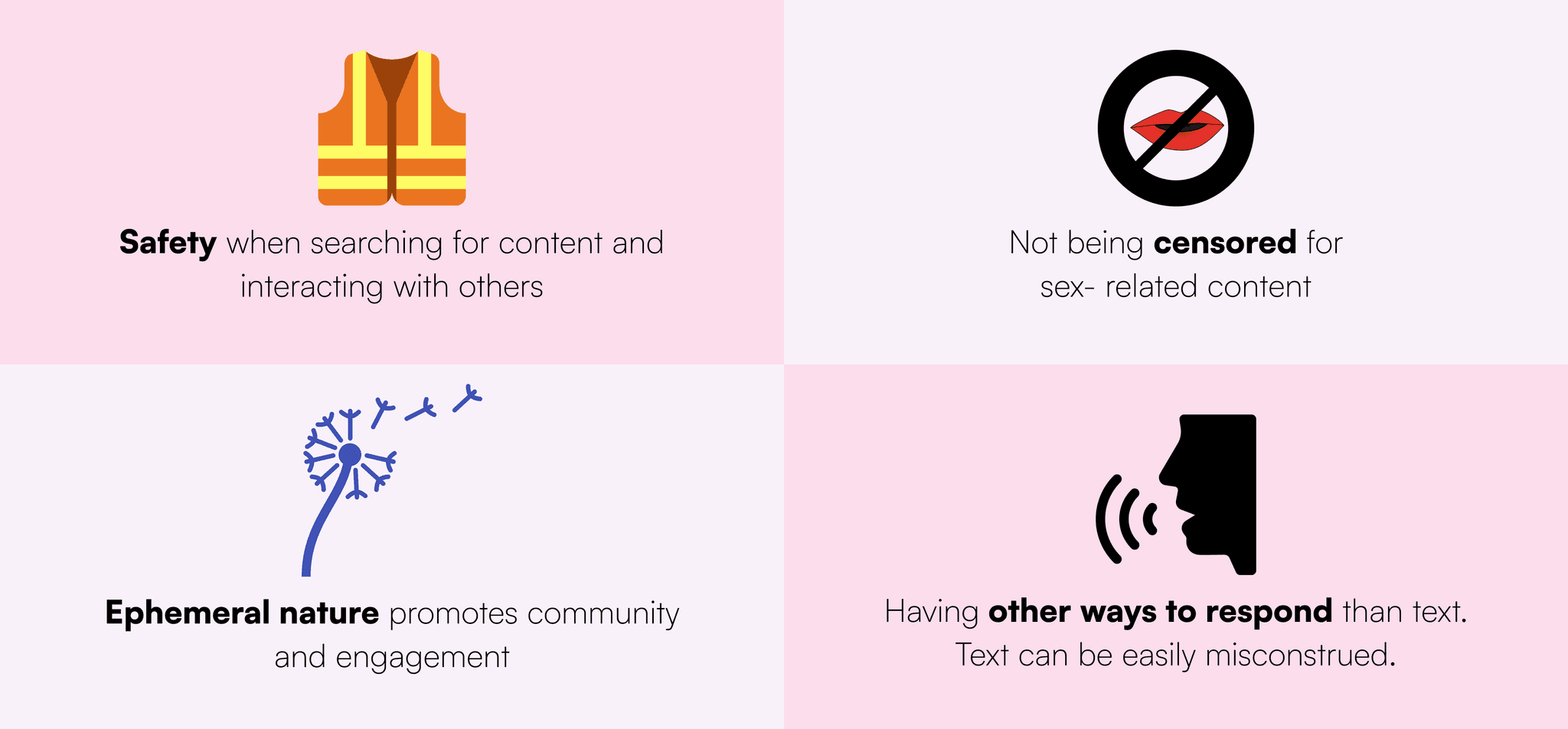
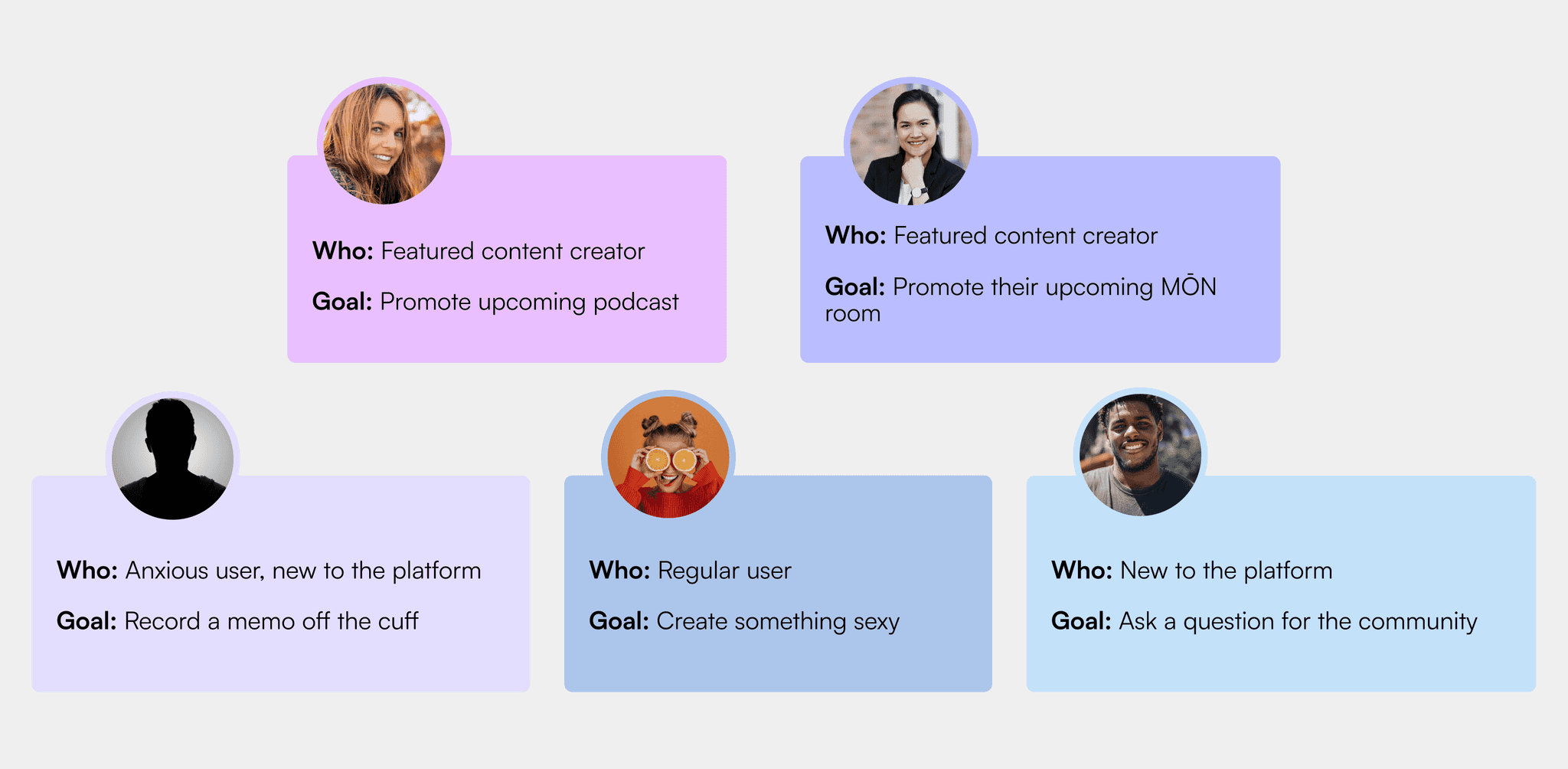
General user wants
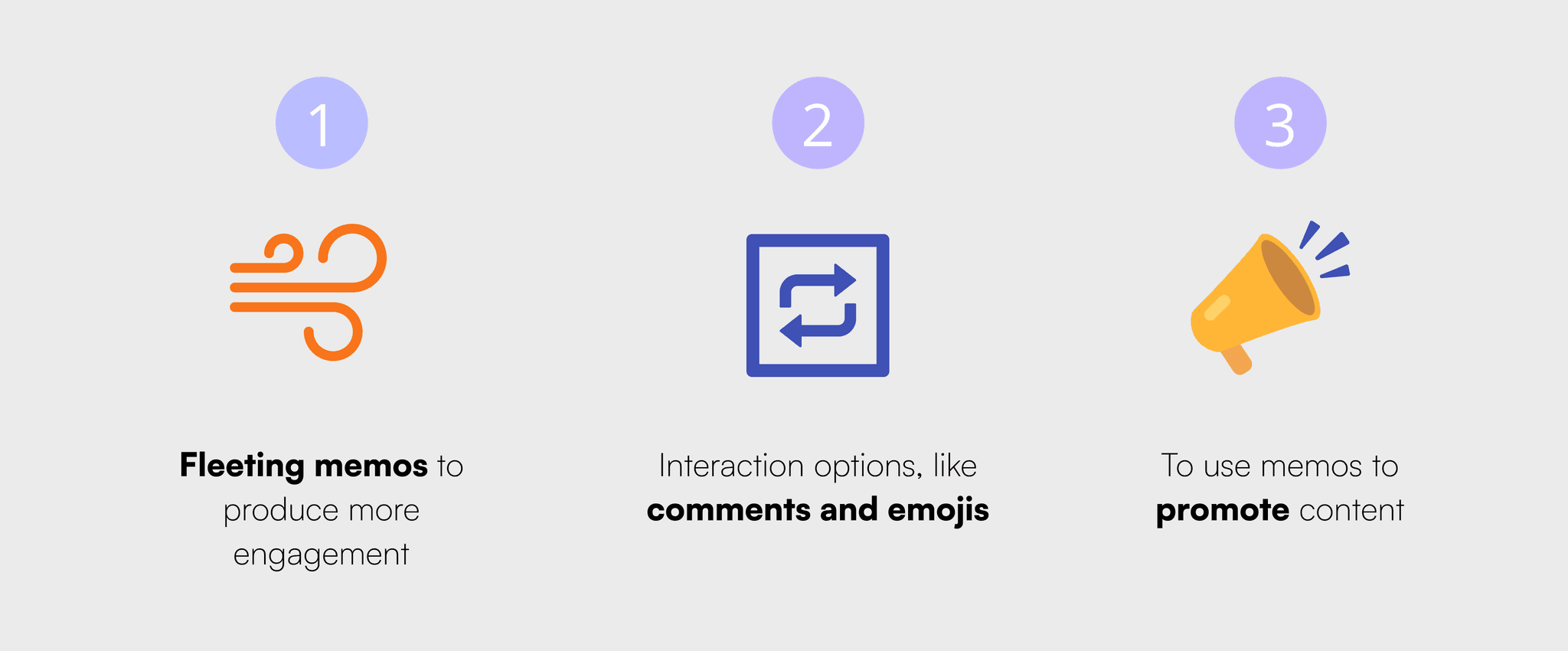
Potential memo creator wants
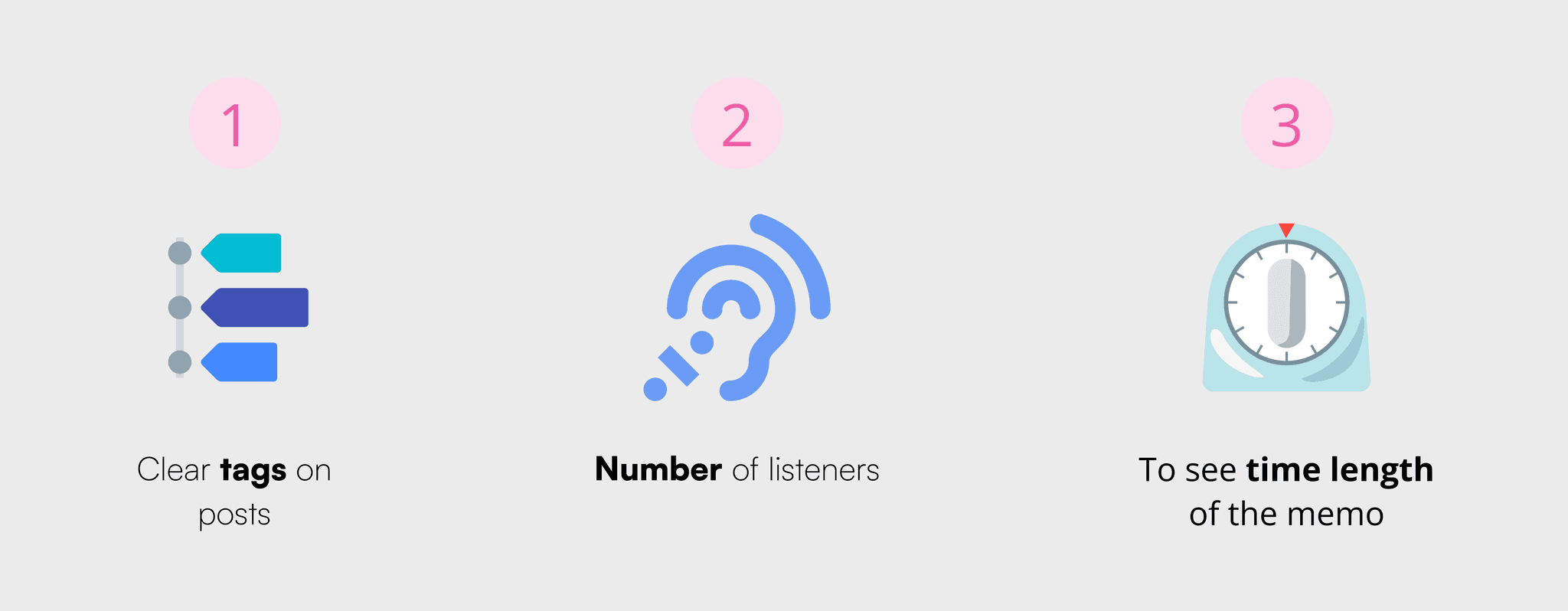
Potential memo consumer wants
How some users would use memo's
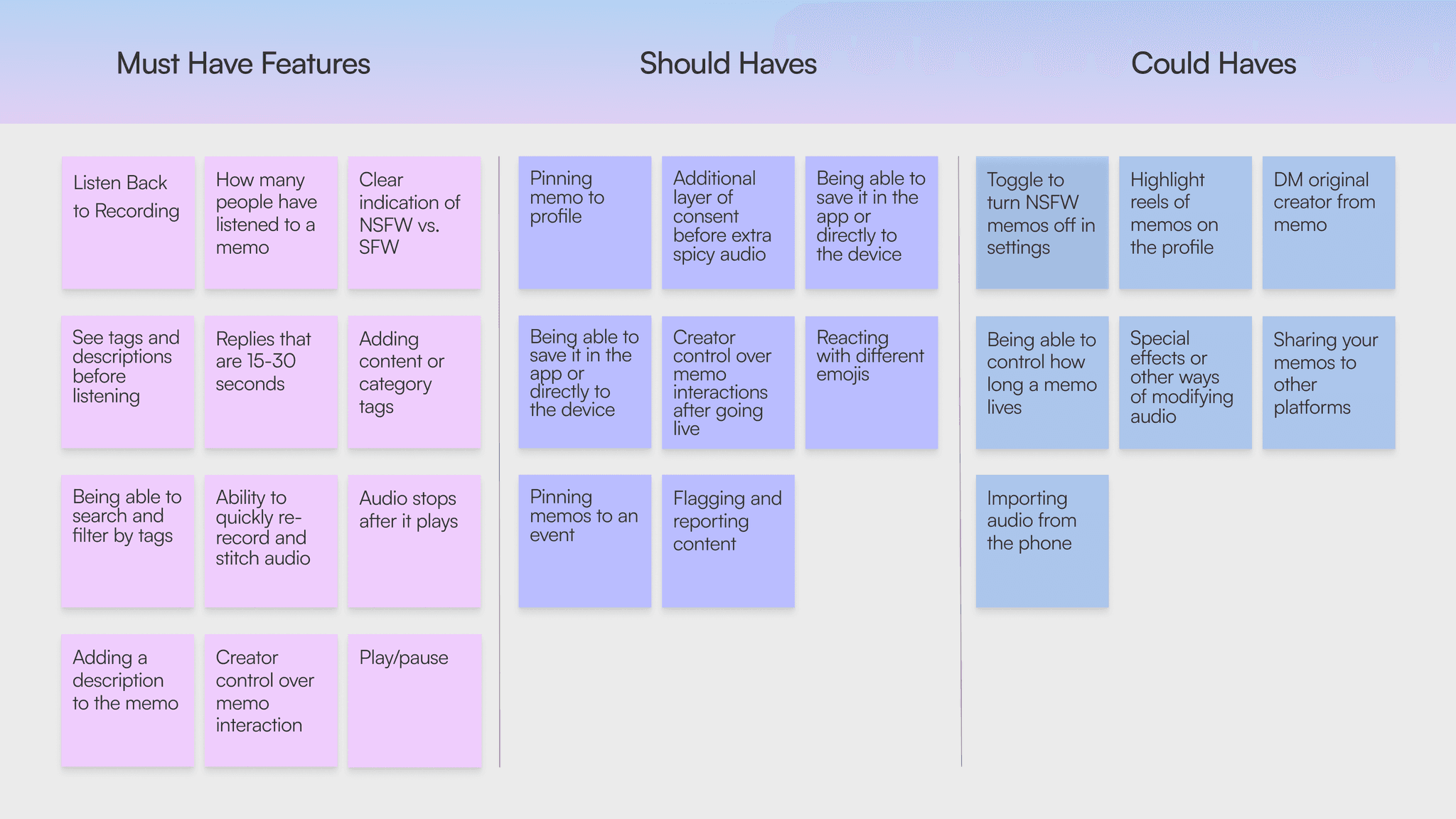
Potential features
Ideation and wireframes

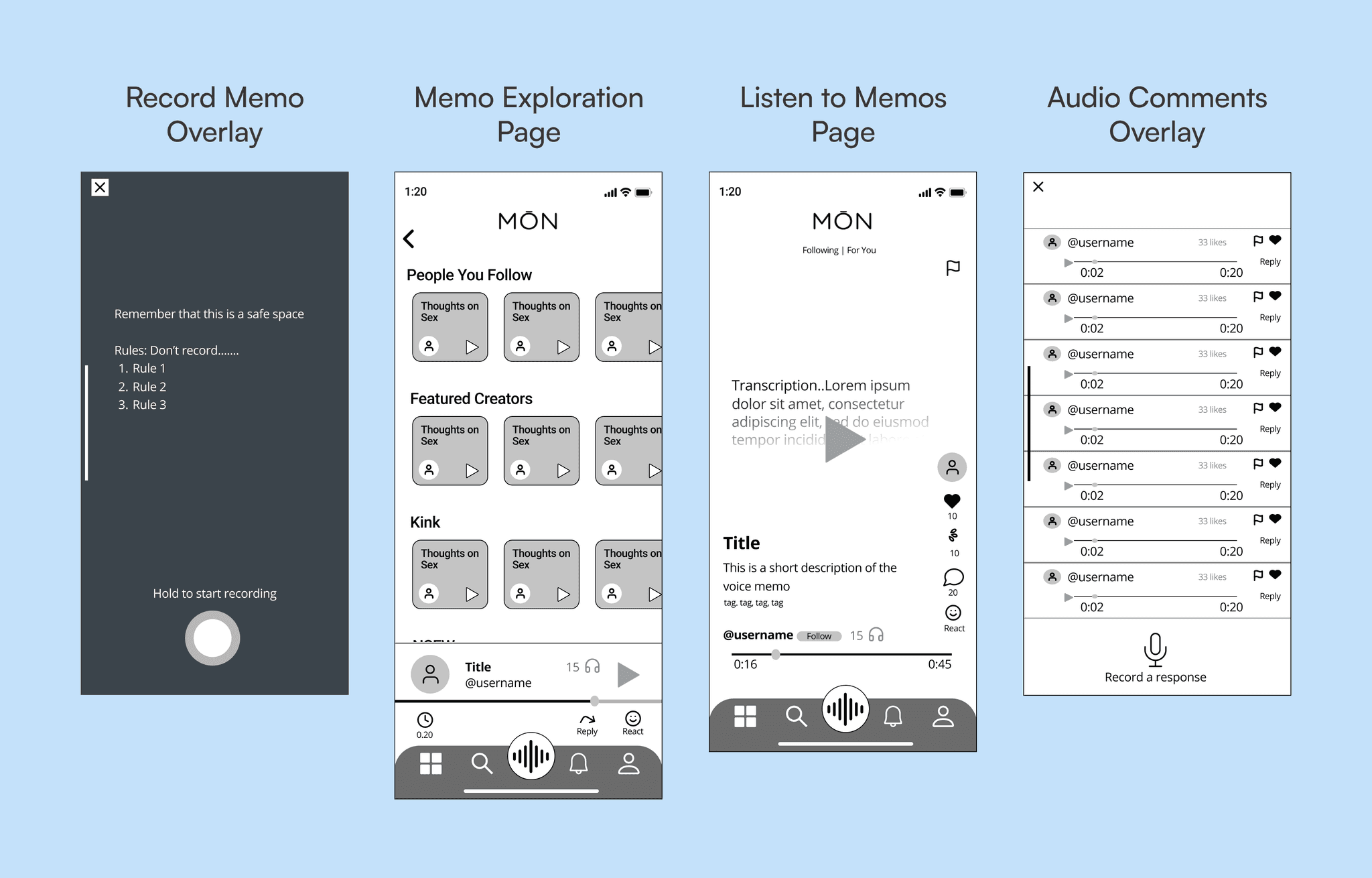
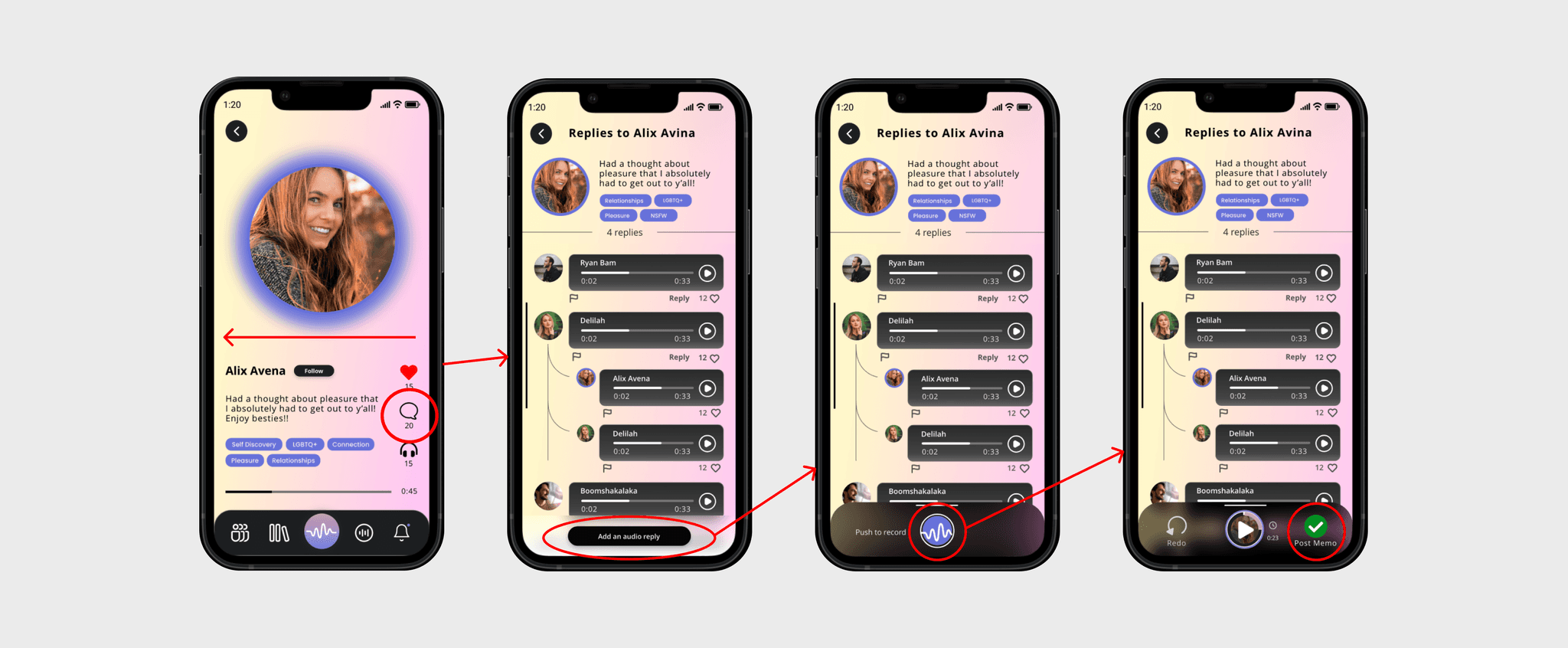
Ideation consisted of two sessions of sketching, in which we selected the best ideas from the team. As interaction design lead I was able to make major contributions to this part of the process by suggesting, what became, the main style of functionality for memos. We gained clear direction for how users would be able to post and interact with memos. We decided to implement a full screen swipe-to-scroll format popular among major social media platforms, but elaborated on common patterns in the design of MŌN memo’s comments and replies. Here, users would be to reply the original post with short fifteen-second audio comments and thread series of additional audio clips off individual comments. The functionality blends patterns established on TikTok and Reddit.

Mid-fidelity memo wireframes
Next, we began considering how to integrate our designs with the current app. We came up with two homepage designs we felt would best meet user’s needs. One version in which the three major types of content (rooms, memos, and podcasts) would be accessible on a single homepage, and one version that split the major types of content onto 3 individual pages.

We could conducted an A/B test to decided which design to use. Below are the two designs that we would A/B test.

Next, we began considering how to integrate our designs with the current app. We came up with two homepage designs we felt would best meet user’s needs. One version in which the three major types of content (rooms, memos, and podcasts) would be accessible on a single homepage, and one version that split the major types of content onto 3 individual pages.

We could conducted an A/B test to decided which design to use. Below are the two designs that we would A/B test.

Next, we began considering how to integrate our designs with the current app. We came up with two homepage designs we felt would best meet user’s needs. One version in which the three major types of content (rooms, memos, and podcasts) would be accessible on a single homepage, and one version that split the major types of content onto 3 individual pages.

We could conducted an A/B test to decided which design to use. Below are the two designs that we would A/B test.

2 home page designs for navigation and content layout
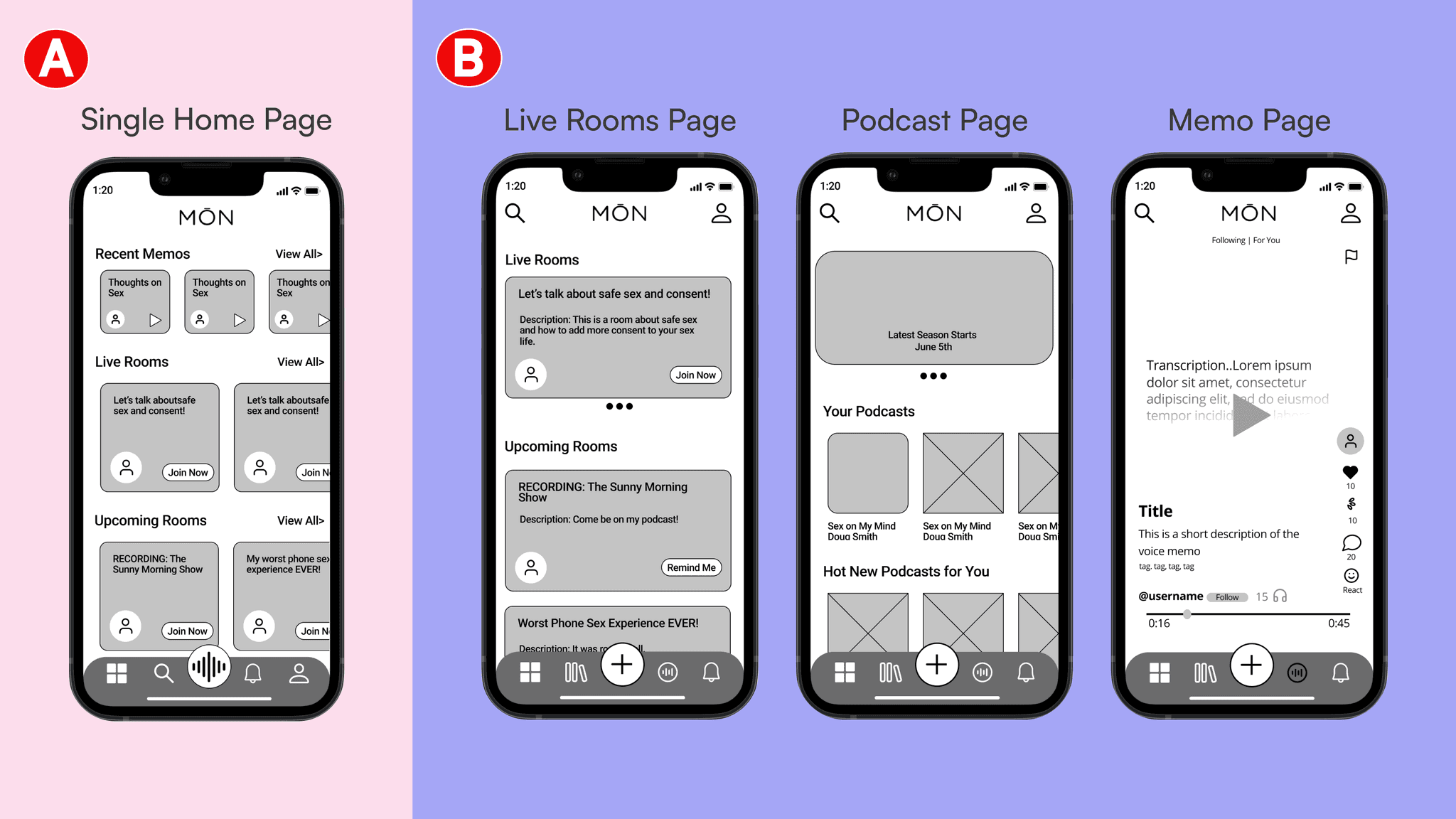
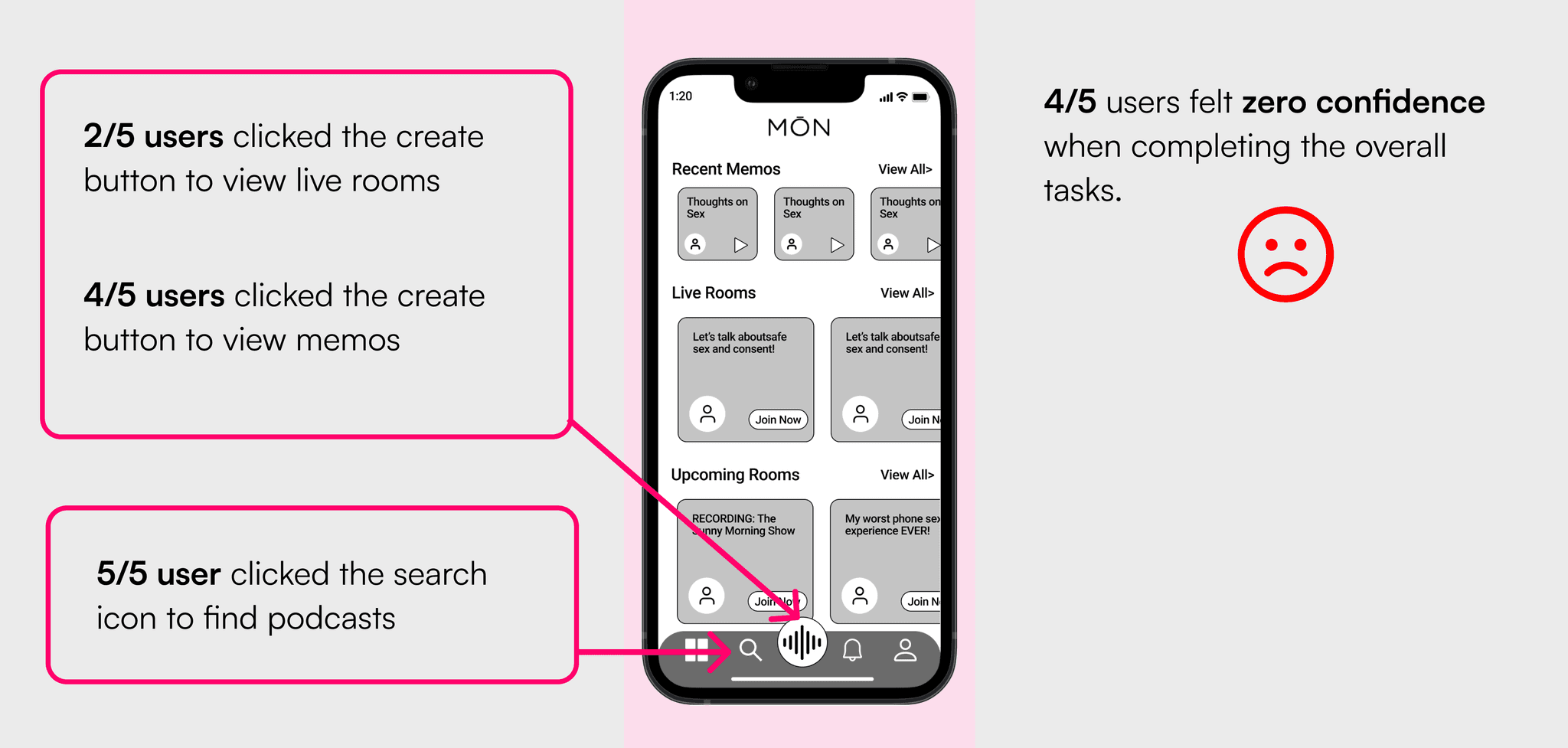
Version A - The single homepage design incorporates the following:
1. Redesign of MŌN’s current homepage design, which builds on MŌN’s design work.
2. Horizontal carousels for memos, live rooms, upcoming rooms, and podcasts.
3. A primary navigation bar that leads to pages whose functions’ are secondary to the apps major content.


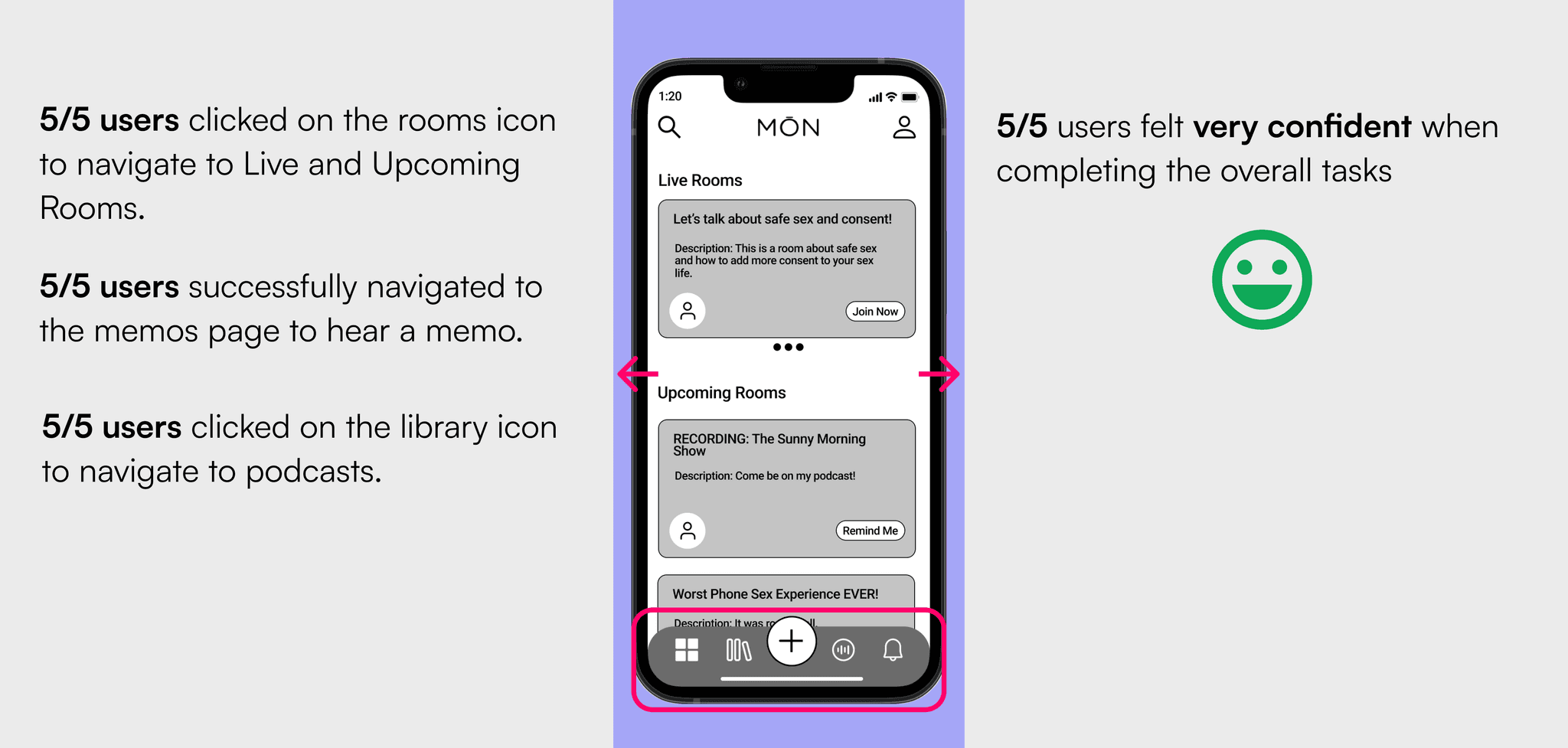
Version B - The multi-page content design incorporates the following:
1. Uniquely designed pages for each kind of content- live rooms, memos, and podcasts.
2. A primary navigation bar takes you to each of these pages and your notifications.
3. Non-content functions have been moved to top navigation, and added to the profile page.

A/B Testing for Homepage (Mid-Fi)

We conducted our A/B tests through Maze, a remote usability testing tool, by creating two separate prototypes and giving users similar series of tasks to complete in each test. There was no crossover, all participants only took the A or the B test.

Single-page home experience test results
Multi-page page home experience test results
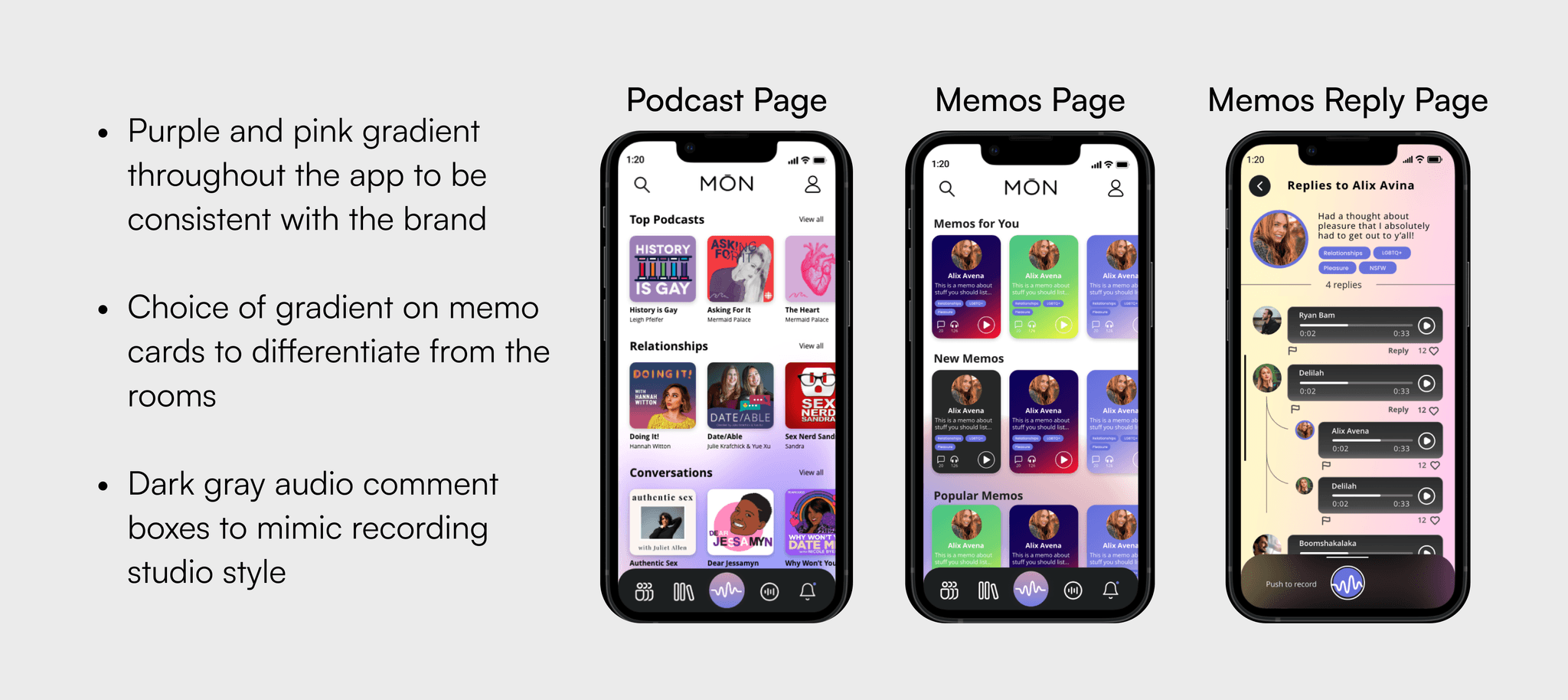
Hi-fi design: color
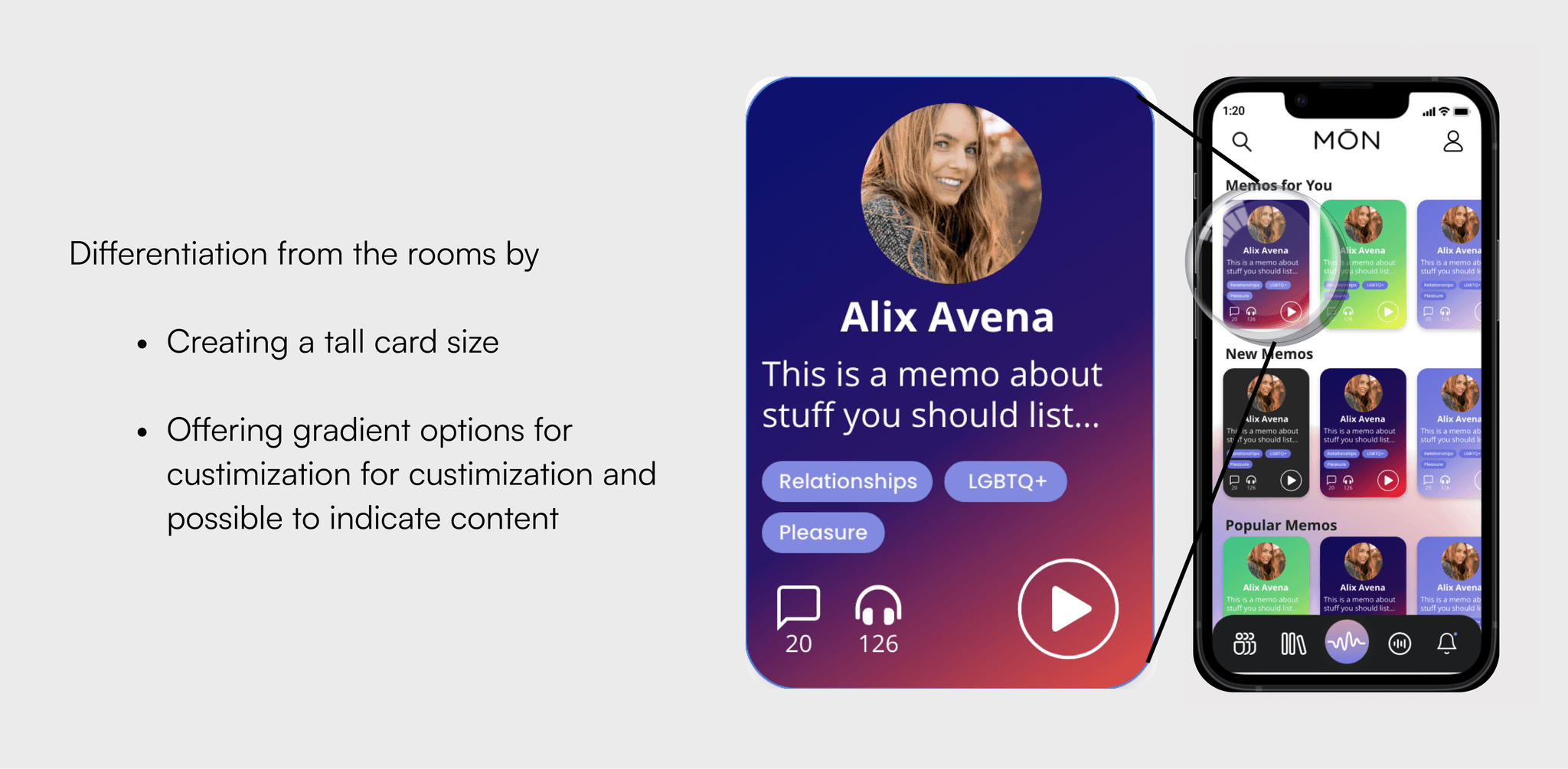
Memo cards
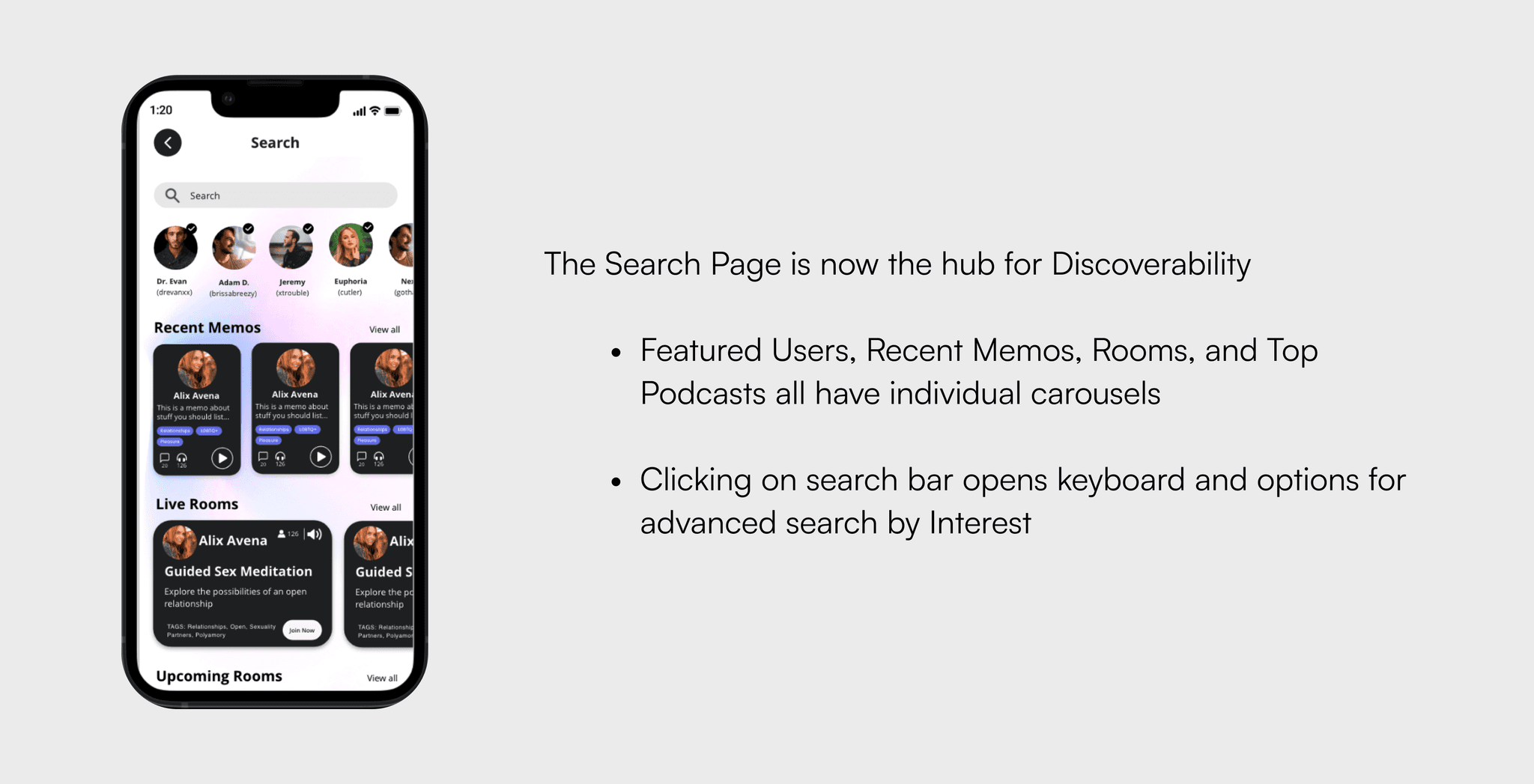
Search page
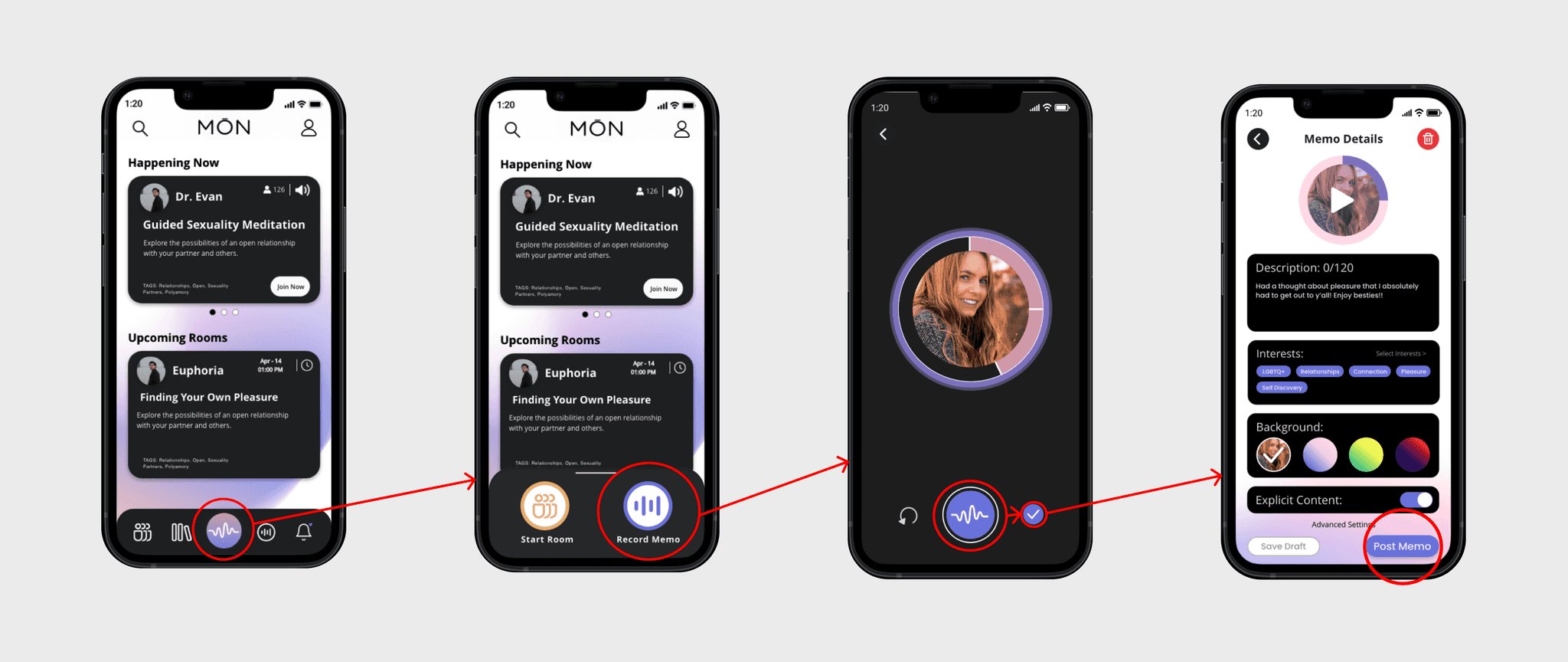
Interaction flow - record and post a memo
Interaction flow - record and post a memo comment or reply
Final round of usability testing via Maze

We conducted a second round of usability testing on our high fidelity prototype with actual MŌN users. Unfortunately this took longer than expected and we did not have time to test revisions made based on this round of testing. Although the results were overall favorable. We passed on a few revisions to MŌN’s CEO as suggested next steps which we did not have time to back up with a third round testing.

Usability Task 1
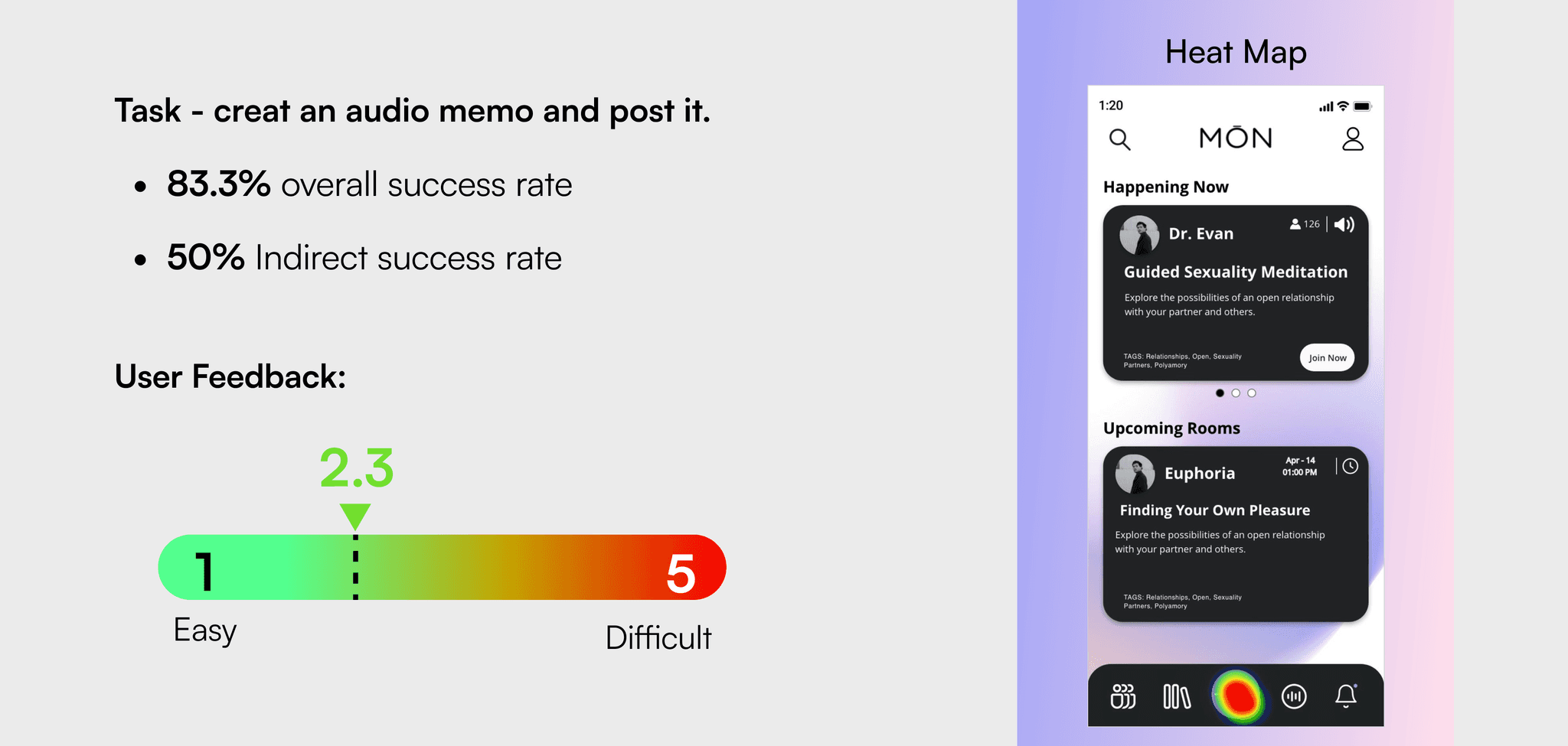
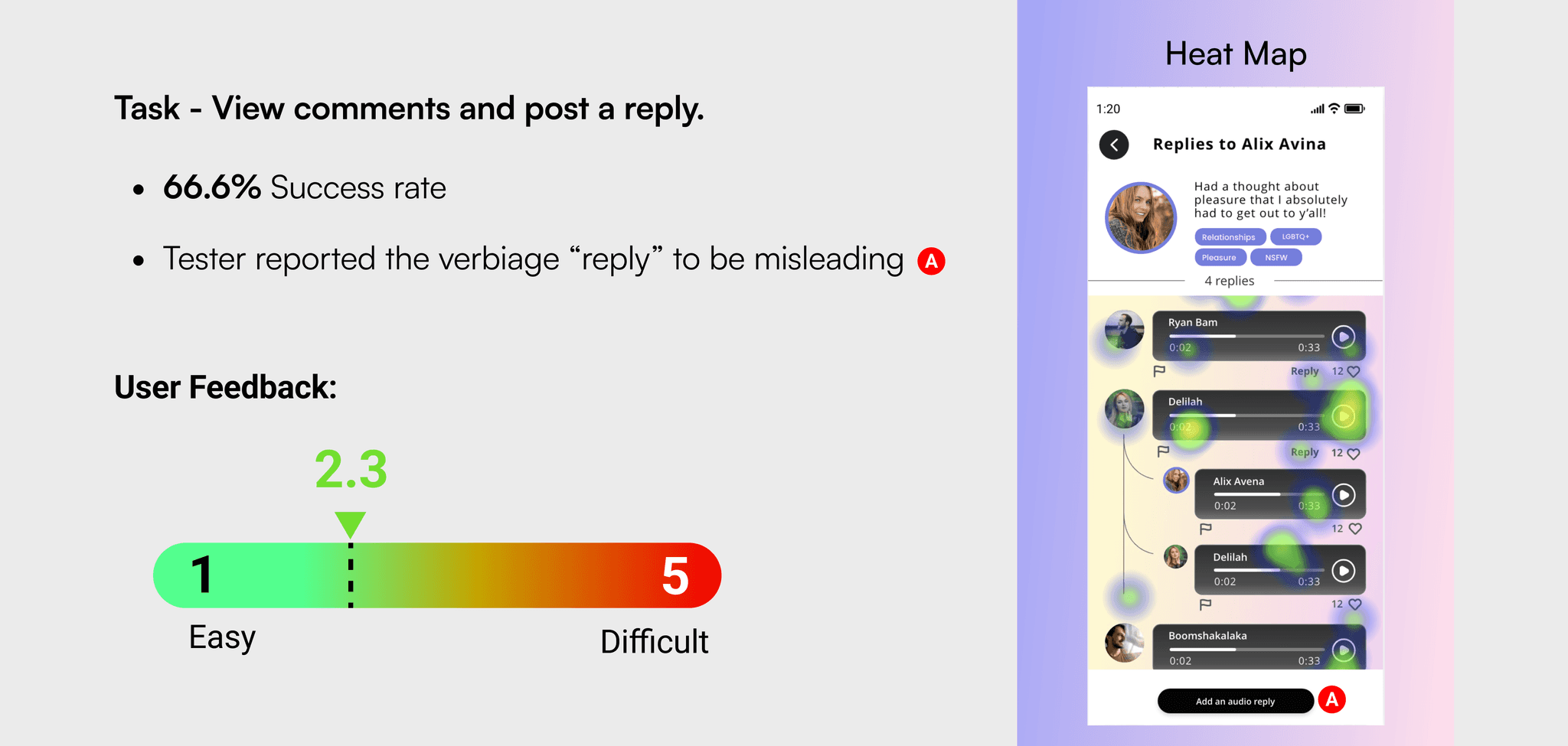
With an overall success score of 83.3% task one was considered a success. The indirect success rate of 50% would be less than desirable, but the rigidity of testing with maze makes it difficult to test alternate routes, routes which I would normally include on purpose. Within the context of this test, the 50% indirect success rate is not considered a negative and was expected.

With an overall success score of 83.3% task one was considered a success. The indirect success rate of 50% would be less than desirable, but the rigidity of testing with maze makes it difficult to test alternate routes, routes which I would normally include on purpose. Within the context of this test, the 50% indirect success rate is not considered a negative and was expected.

With an overall success score of 83.3% task one was considered a success. The indirect success rate of 50% would be less than desirable, but the rigidity of testing with maze makes it difficult to test alternate routes, routes which I would normally include on purpose. Within the context of this test, the 50% indirect success rate is not considered a negative and was expected.

Usability Task 2

The results of usability task two were considered passable, but less than optimal. The team was confidant in shipping this design provided it was paired with suggested revisions as next steps. We felt it would be wise to improve the call to action on the memo comments page. We sent a few possible redesigns, which will be discussed below. As mentioned before, these revisions were not implemented because there was not time to properly test them.

Additional tasks were included in the usability test but are not included in this case study.

Final Iteration

Next steps

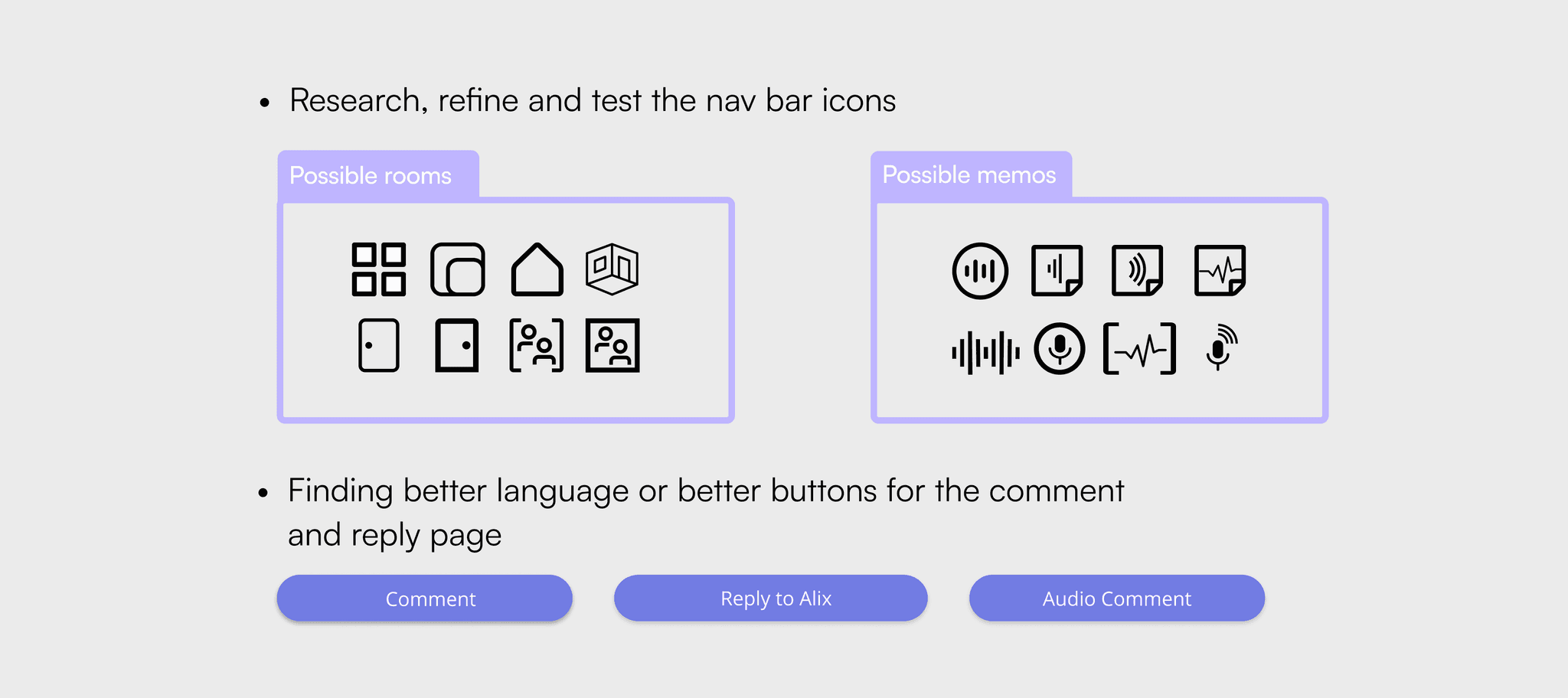
As mentioned previously, the time restraints of this project did not allow for all aspects of the design to be tested as throughly as we felt necessary. Bellow are some possible navigation icons we included with our designs to be tested. As well as, possible call to action buttons that could be tested for the memo comments page.

Recommendations for further testing
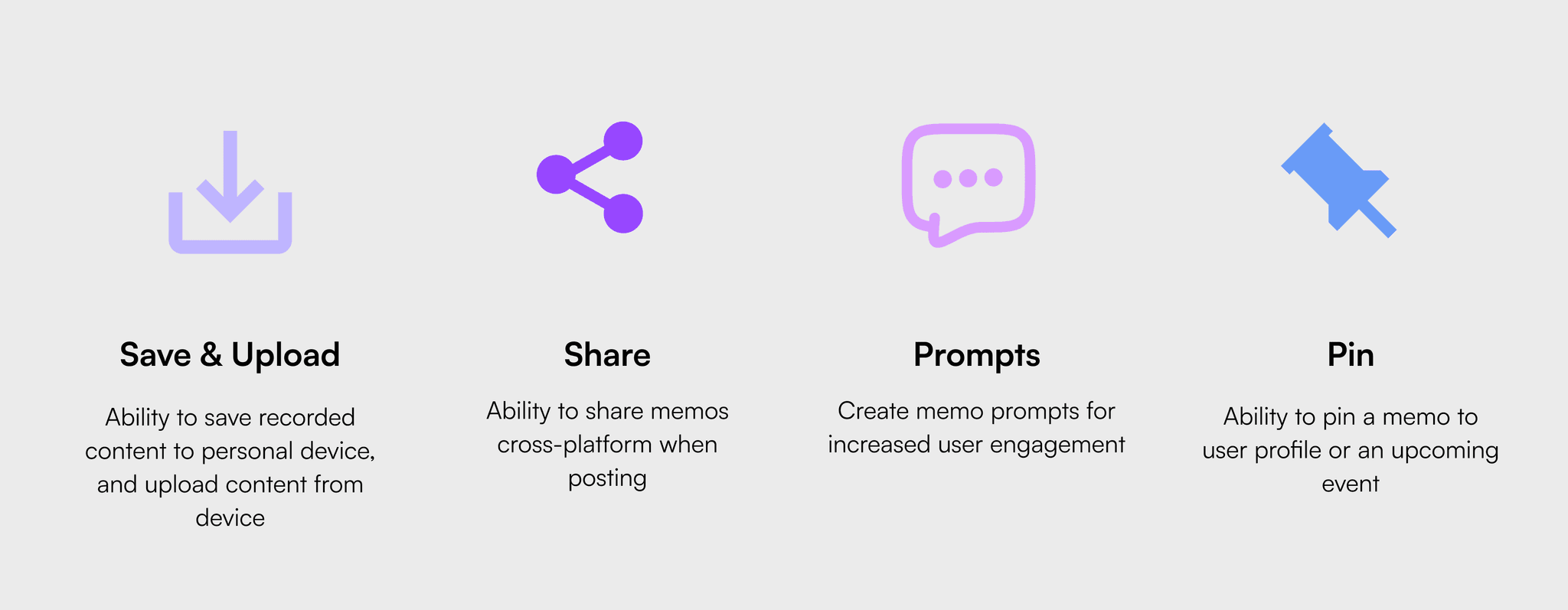
Being that MŌN is currently a MVP, my team was asked to design the memos feature as an MVP as well. We did not include solutions to some of the problems we found in our research. Based on our research, we recommended including the following features to meet user needs and wants when possible.

Future considerations
Personal Takeaways and Lessons learned

I was really excited to work on this project for numerous reason. Social audio apps like Clubhouse and Beams are growing in popularity right now. I personally find them interesting because theres opportunity explore cultural impact and influence in this new area of social media and theres opportunity for users to be creative in new ways with the limitations of audio only content. Additionally, I was more than thrilled to work with a company that pushing the limits of social constructs in numerous areas including freedom of speech on the internet, internet sex work, and most of all society’s general comfort level around discussing sex in positive and healthy ways. There were lots of opportunities to consider things like “what does consent look like in this situation,” “how can we keep or users safe,” and “how can we give users the tools they need to express themselves.” This was more than your run-of-the-mill bootcamp project, no disrespect to anyone.

All that being said this was a huge learning experience for me. Working on FosterRoster I worked with a specific client, but it was casual. We interacted with MŌN as a formal client. We scheduled meetings, prepared agendas, conducted a discovery session, signed a non-disclosure agreement, created and upheld a scope of work and schedule, planed research interactions with actual users, fielded stakeholder questions and concerns, educated stakeholders about the UX process, listened to and weighed-in stakeholder push back while advocating for users, and in the end handed-over agreed upon design files and deliverables.

Thanks for sticking with me this far! I realize this one’s on the longer side. If you’d like to discuss this or anything else in more detail, I encourage you to reach out to me. My info can be found below.